Learn more about addiction.

The opioid crisis peaked in 2015, with upwards of 250 million opioid prescriptions, causing wide-scale devastation and an enduring fear.1 The enormity of the scale of the crisis prompted a nationwide effort to reduce opioid prescribing.1
Today, there are still roughly 120 million opioid prescriptions written annually.2 While fewer patients are being exposed to opioids and their side effects – and fewer people are being exposed to the risks of addiction that opioids present1,3 – the drive to continue to lower the number of opioid prescriptions continues.1 The need for safe, effective pain treatment remains widely felt in doctors’ offices across the US.
At Adneuris Therapeutics, we understand that the opioid addiction crisis is a complex problem that demands innovative and disruptive solutions, including safer, more effective treatments. Based on promising early data, Adneuris is evaluating the potential of its investigational therapy, cebranopadol, to treat opioid use disorder (OUD), which could help change the trajectory of the millions of lives affected by this disease.
The global impact of opioid addiction
Overuse, misuse and dependence on opioids is having a devastating impact on individuals, families and communities worldwide. Current treatment options for OUD have been insufficient to address this public health crisis, and new approaches are desperately needed. In addition to studying its unique potential in pain treatment, Adneuris is exploring cebranopadol’s potential to safely and effectively treat OUD.
Euphoria and the negative impact of dependency
Opioids can produce a euphoric effect, but that pleasurable effect may diminish over time, often requiring more frequent dosing to achieve the same effect.
Taking an opioid regularly increases the likelihood of addiction and physical dependence. If not treated, opioid use disorder can lead to overdose and death.*
*The Johns Hopkins University. Opioid Use Disorder. Johns Hopkins Medicine. https://www.hopkinsmedicine.org/health/conditions-and-diseases/opioid-use-disorder Accessed January 22, 2026.
Opioid misuse and the addiction crisis
- Over 5 million Americans age 12 and older misused opioids in 2020.4
- 9.3 million people misuse opioids in the US.4 Prescription opioid misuse can lead to the misuse of illicit opioids, including synthetic opioids and heroin.
- 80% of heroin users reported using prescription opioids first.4
- 82,000 died in the US from opioid overdose in 2022.5
- The cost of the opioid crisis in the US totaled nearly $1.5 trillion in 2020.6
- Pain is reported in nearly 80% of emergency department visits in the US.7
New science offers a potential solution
We believe cebranopadol has the potential to become the new standard-of-care treatment for Opioid Use Disorder (OUD).
Drugs like morphine and oxycodone may cause euphoria and addiction through their interaction with the µ-opioid peptide (MOP) receptor. In fact, a recent study showed that 25% of patients given medication like morphine or oxycodone in an emergency department setting experienced feelings of euphoria in addition to pain relief.8 Current treatments for OUD work primarily by blocking the MOP receptors, leaving fewer receptors free to be stimulated by drugs of abuse. Existing pharmacotherapies for OUD may be effective, but have shortcomings that include difficulty accessing treatment and poor treatment retention – and none fully address the needs of patients.9
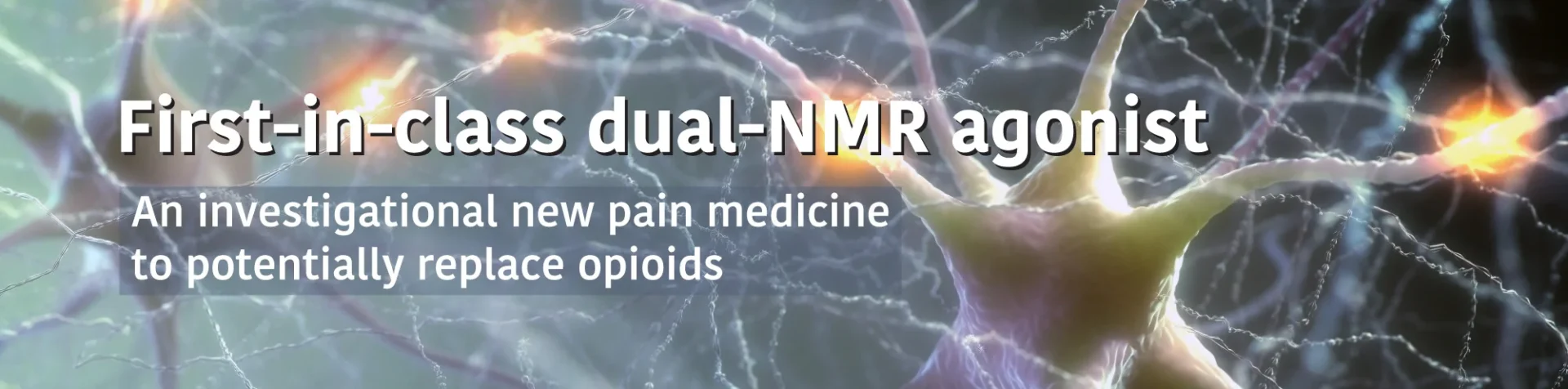
As a first-in-class investigational dual nociceptin/orphanin FQ peptide (NOP) receptor and MOP receptor (dual-NMR) agonist, cebranopadol has the potential to offer a safe and highly effective treatment for OUD. By simultaneously stimulating the NOP and MOP receptors, cebranopadol has demonstrated in preclinical studies that it may block the effects of attempts to misuse opioids and other potentially addictive substances, while also blunting the high and euphoria associated with MOP stimulation.
References:
- CDC. CDC Guidelines for Prescribing Opioids for Chronic Pain – United States, 2016. Available at https://www.cdc.gov/mmwr/volumes/65/rr/rr6501e1.htm
- CDC. United States Dispensing Rate Maps. 2026. Available at https://www.cdc.gov/overdose-prevention/data-research/facts-stats/us-dispensing-rate-maps.html
- CDC. Opioid Dispensing Rate Maps. 2026. Available at https://www.cdc.gov/overdose-prevention/data-research/facts-stats/opioid-dispensing-rate-maps.html
- Substance Abuse and Mental Health Services Administration (SAMHSA). Key Substance Use and Mental Health Indicators in the United States: Results from the 2020 National Survey on Drug Use and Health. https://www.samhsa.gov/data/sites/default/files/reports/rpt35325/NSDUHFFRPDFWHTMLFiles2020/2020NSDUHFFR1PDFW102121.pdf Accessed January 22, 2026.
- CDC WONDER Database. Accessed 05/29/2024 via online site https://nida.nih.gov/research-topics/trends-statistics/overdose-death-rates.
- Joint Economic Committee. The Economic Toll of the Opioid Crisis Reached Nearly $1.5 Trillion in 2020. https://www.jec.senate.gov/public/_cache/files/67bced7f-4232-40ea-9263-f033d280c567/jec-cost-of-opioids-issue-brief.pdf Accessed January 22, 2026.
- Hackworth JC, Schneider JE, Do Valle M, et al. The burden of acute pain in the U.S. in the wake of the opioid crisis. Front Pain Res. 2025;6:1642035.
- Abril Ochoa L, Naeem F, White DJ, Bijur PE, Friedman BW. Opioid-induced Euphoria Among Emergency Department Patients With Acute Severe Pain: An Analysis of Data From a Randomized Trial. AcadEmerg Med. 2020 Nov;27(11):1100-1105.
- Sofuoglu M, DeVito EE, Carroll KM. Pharmacological and Behavioral Treatment of Opioid Use Disorder. Psychiatr Res Clin Pract. 2018;1(1):4-15. Published 2018 Dec 5. doi:10.1176/appi.prcp.20180006
*Based on the results from two phase three trials **As demonstrated by the results from two human abuse potential (HAP) studies